
CNC Turning Services for Shafts and Cylinders
FOR SHAFTS & CYLINDERS THAT HAVE TO RUN TRUE
If your part is round, spins, seals, or supports a load, it lives or dies by the turning work behind it. Lindsay Machine Works runs CNC turning services for shafts, cylinders, sleeves, bushings, flanges, and rolls in envelopes most job shops cannot hold, with the inspection discipline to prove the tolerances your print calls for.
Long shafts, oversized cylinders, hardened wear surfaces, and one-setup turn-mill work all move through the same shop, so your job stays with one team from raw bar to finished part.
Turning Capacity, End to End
CNC turning services at Lindsay Machine Works cover the full range of rotational work, from precision components a few inches long to large industrial shafts and drums. If a shop’s turning envelope has ever pushed your project onto a plane or a truck to another vendor, this is where that stops.
Turned envelope includes:
- CNC turning centers with live tooling and a sub-spindle
- CNC Turning center up to 26-inch OD by 80 inches long
- Standard CNC turning centers for high-volume shafts, bushings, and flanges
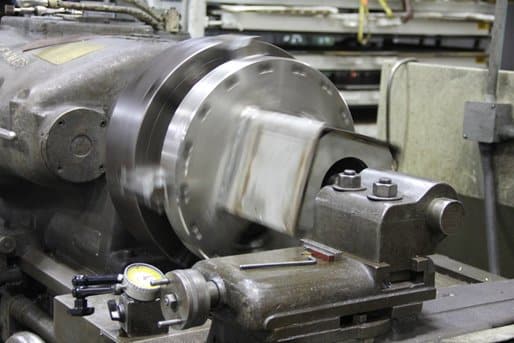
- Manual engine lathes up to 39-inch OD by 240 inches long for long shafts, rolls, and pins
- Vertical turning lathe up to 57-inch OD for drums, large cylinders, and heavy rotating parts
- Gundrilling up to 1 inch OD by 40 inches deep for hydraulic bodies, manifolds, and long bores
That envelope covers hydraulic cylinder rods, drive shafts, mill rolls, printing rolls, pump shafts, spindles, and industrial cylinders that other shops cannot fit on a table.
Tolerances You Can Hold to the Print
Turning is only as good as the inspection behind it. Every turned job at Lindsay Machine Works passes through a climate-controlled inspection area, with a Starrett AV350 vision and probe system, a Mitutoyo CMM, calibrated micrometers, and digital height gauges checking the part against the print.
For most turned parts, tolerances down to a few thousandths of an inch are held routinely on the CNC turning centers. When the print demands tighter cylindricity, roundness, or surface finish, ID and OD cylindrical grinding follows turning to bring the part in on Ra value and diameter. Concentricity between features can be protected on turning centers with live tooling, where the part sees fewer setups.
First article inspection reports and material certifications are available on request. Programs and fixtures stay on file, so a repeat order runs the same as the first order.
Common Shaft and Cylinder Work
The team turns shafts and cylinders across a wide range of applications, including:
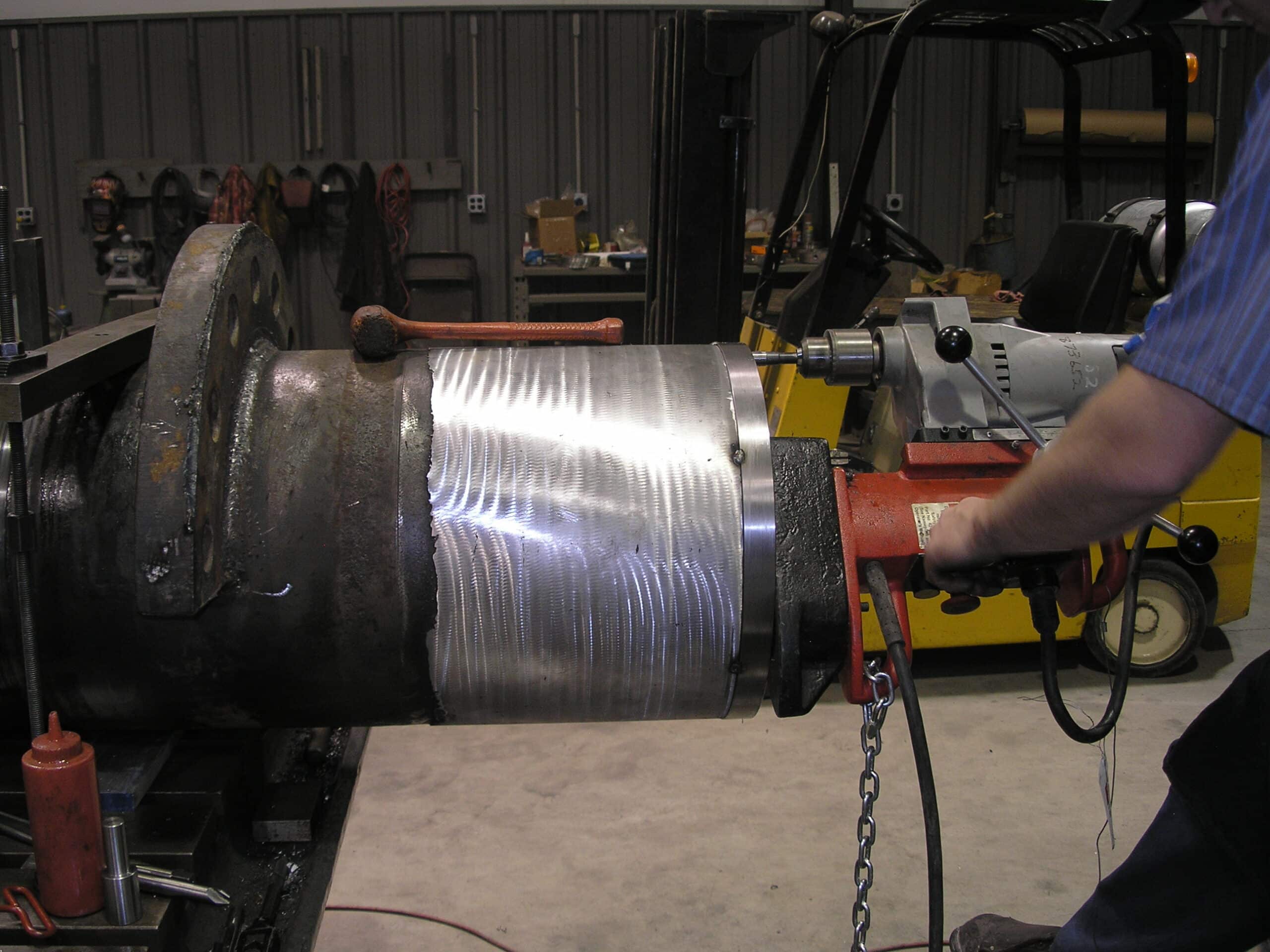
- Hydraulic cylinder rods, glands, and piston bodies
- Drive shafts, output shafts, and gearbox shafts
- Mill rolls, printing rolls, and coating rolls
- Pump shafts, sleeves, and impeller components
- Spindles and machine tool components
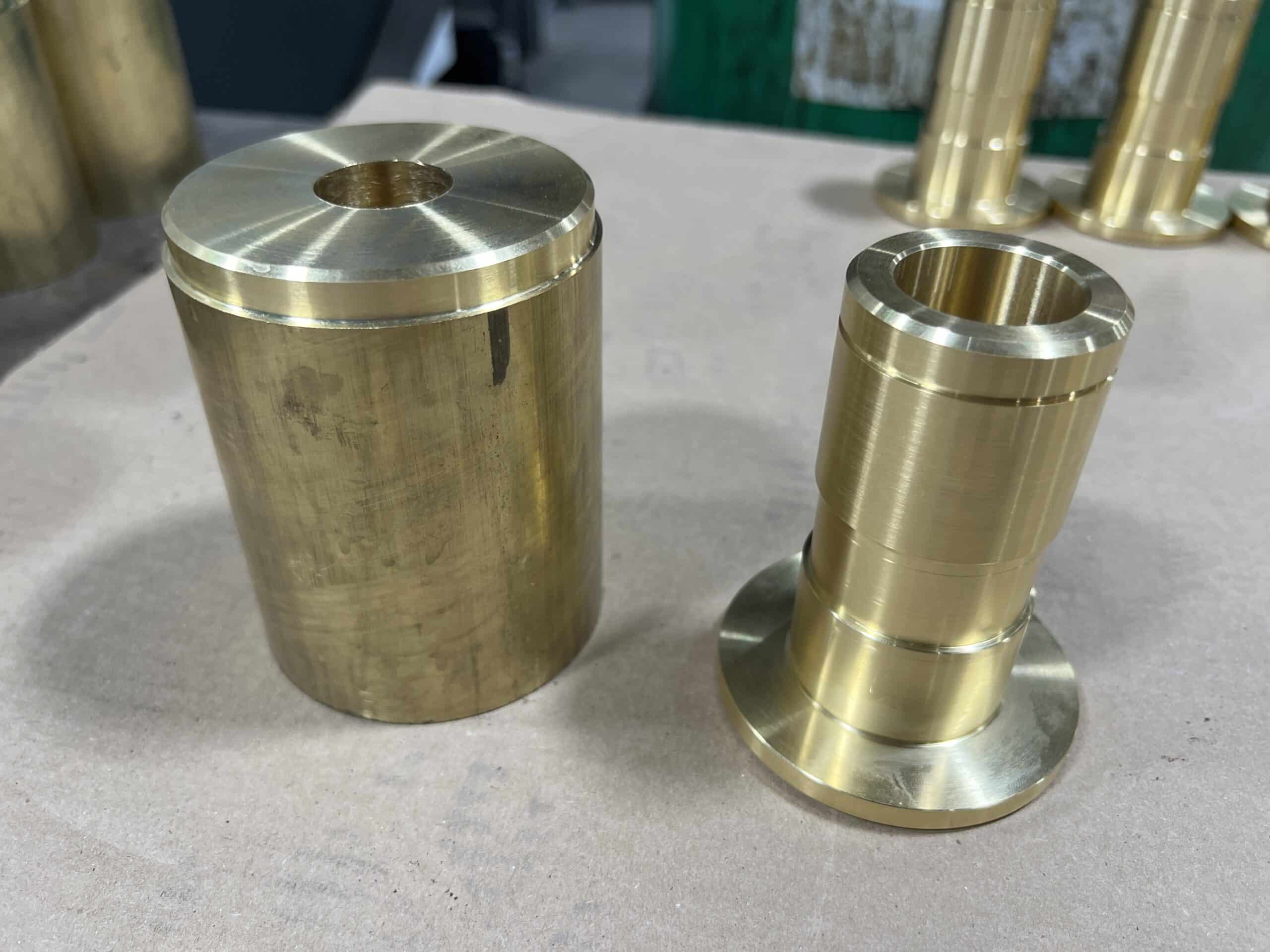
- Bushings, sleeves, and wear rings
- Flanges, adapters, and threaded couplings
- Large drums and machined cylinders for industrial equipment
If your shaft or cylinder is legacy work with no current OEM support, the reverse engineering team can capture the geometry from a worn part and produce a clean drawing along with the finished replacement.
Industries We Serve
Turned work at Lindsay Machine Works supports customers across:
Read more on the OEM parts and metal fabrication for manufacturing page.
Materials for Turned Work
The right shaft or cylinder starts with the right material. Lindsay Machine Works turns work in:
- 1
Carbon and alloy steels, including 1018, 1045, 4140, and 4340 for shafts, pins, and general rotating parts
- 2
Stainless steel, including 303, 304, 316, and 17-4 PH for shafts and cylinders that see corrosion, washdown, or chemical exposure
- 3
Chrome-plated bar for hydraulic cylinder rods
- 4
Tool steels for high-wear surfaces
- 5
Aluminum, including 6061 and 7075, when weight matters
- 6
Bronze for bearing surfaces, bushings, and wear rings
- 7
Titanium for industrial and defense applications
- 8
Engineering plastics for low-wear rotating parts
Material can be supplied by you or sourced through Lindsay Machine Works with full traceability. Certifications stay on file with the job.
Turn-Mill and Secondary Operations
Most shafts and cylinders are not purely turned parts. Keyways, cross holes, flats, threads, and journals often follow the primary turning operation. Because milling, grinding, gundrilling, and fabrication all live under the same roof, secondary work does not push your part off-site.
Common combinations include:
- Turning, then milling keyways or flats, on 4-axis or 5-axis mills
- Turning, then gundrilling deep bores in hydraulic bodies and manifolds
- Turning, then welding for shafts that need repair, build-up, or attached features
- Turning, then heat treating coordinated through trusted partners
That single-shop workflow protects the tolerances the print already calls for.
Why Buyers Choose Lindsay Machine Works for Turned Work
Turning is a specialty at Lindsay Machine Works. The shop has been producing precision shafts, cylinders, and rotating components for OEMs, contract buyers, and end users for more than 30 years. With more than 80 machines in a 35,000 square foot facility and turning envelopes that stretch to 57-inch OD and 240 inches long, capacity is rarely the limiting factor on a project.
You get manufacturing engineering support on every quote, a single point of contact, and inspection records that tie the finished part back to your print.
Service Area
Lindsay Machine Works is located at 4023 N. Cobbler Road in Independence, Missouri, just outside Kansas City. CNC turned shafts and cylinders ship across the country. Local OEMs, dealers, and repair facilities can pick up finished parts directly, and shop tours are welcome.
Frequently Asked Questions (FAQ) for CNC Turning for Shafts and Cylinders
Call Lindsay Machine Works at (816) 257-1166 or Request a Quote to Start your Project
Send a drawing, a 3D model, or the worn part on your bench. You will get a quote, a lead time, and clear answers fast.